
Mastering the Art of Asking and Listening
A Reflection on Trust and the Work of Oral History
By Agnieszka Ilwicka-Karuna
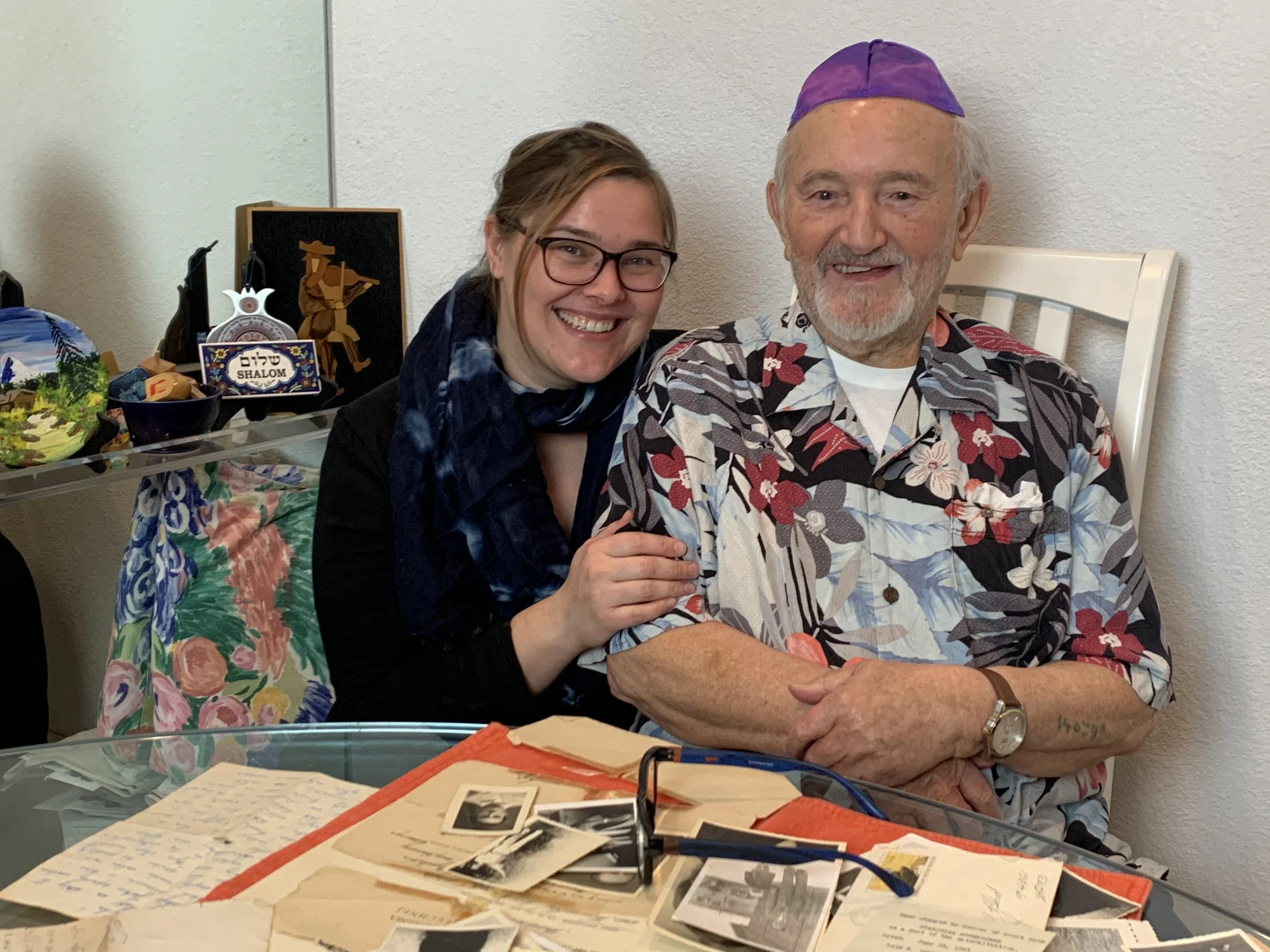
Henry (Hershl Tzvi) Estreicher, Holocaust survivor from Myszkow, Poland, was interviewed by Agnieszka Ilwicka-Karuna on Feb. 16, 2020, in San Jose, CA. (Photo courtesy of Aga Ilwicka-Karuna)
Oral history is the most intimate way of working with primary sources that I have encountered. I have always been drawn to people’s stories, but I began conducting formal interviews as a Field Fellow for the Yiddish Book Center’s Wexler Oral History Project. From Yiddish scholars and artists to native speakers and students, I recorded conversations across five countries and in three languages: Yiddish, English and Polish. Over the last two years, my work has continued at the Samuel Proctor Oral History Program, where I have interviewed veterans of World War II, the Korean War and the Vietnam War — and, whenever possible, their spouses. Each interview, regardless of language or context, has taught me something new about the human need to share and to be heard.
One lesson rises above the rest: a great interview depends on trust. Even the sharpest question falls flat without it or feels intrusive. I have learned to approach each conversation with the intention of listening and creating a space where people feel safe enough to speak from the heart. Skills in oral history are developed from various sources: practice, conferences and mentors. One of the most important sources has been simply watching interviews.
As a doctoral student of Jewish history, I draw deeply from the world’s great oral history collections. The University of Southern California Shoah Foundation Visual History Archive, with its 55,000 survivor testimonies, remains one of the most powerful tools for understanding Jewish life before, during and after the Holocaust.
Today, I am building my own archive of interviews on Jewish life in postwar Poland. This feels like a race against time — the last moment to record voices that still carry memories of surviving the Holocaust, rebuilding family life and navigating the complicated terrain of the postwar decades. Before each interview, I do everything I can to understand the narrator’s story. Once the recording starts, my priority is to listen. Each conversation is a moment of deep trust, a gift of personal memory shared first with me and then with a broader public.
Agnieszka (Aga) Ilwicka-Karuna is a PhD candidate in Jewish Studies at the History Department of the University of Florida. Her work focuses primarily on post-war migration, language, women's and children's history, memory, politics, philanthropy and last but not least, oral history. Aga graduated from the Jewish Studies program at the University of Southampton with a Master of Research. She holds a Master of Arts and a BA in Humanities from the University of Wrocław.